

Canker sores in the mouth can be extremely bothersome and painful. Most people have experienced small, white sores in their mouth at least once in their lifetime. These sores are called canker sores. Although they are usually not associated with any other disease, canker sores in the mouth can be extremely annoying.
Due to their sensitivity, unpleasant pain occurs from any contact, inadequate mechanical movement, irritation from food and beverages, and even during communication. During the period when canker sores are present in the oral cavity, people generally have difficulty eating and even speaking, which can be quite frustrating.
Just when you forget about them and start to eat something or say something, a warning pain appears, just to remind you that they are still there.
What are canker sores?
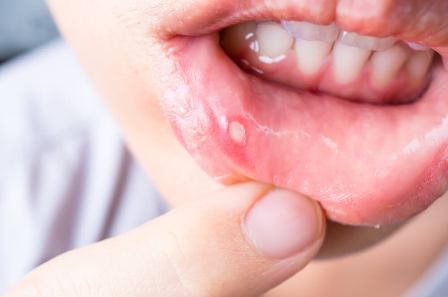
Canker sores are painful sores in the mouth, most often whitish in color, although they can also be gray or yellow. They are generally round or oval in shape.
They appear in the mouth on soft tissues, mainly on the mucosa of the cheek, under the tongue, on the soft palate, on the gums, on the lips, and can also appear on the tongue, primarily on the sides or root.

Canker sores in the mouth are not contagious and usually disappear on their own after two weeks. However, if the canker sore is present for a longer period, if it is painful or large, it is advisable to visit a dentist and get rid of it.
Adults, primarily women, as well as those with genetic predispositions and weaker immunity, are at greater risk of developing canker sores in the mouth. The word “canker” in literal translation from the Greek language means “ulcer on the lips”.
Symptoms of canker sores in the mouth
Before the appearance of each canker sore, that area becomes red, and you usually feel slight tingling or itching. Soon a fluid-filled blister forms at that spot, which bursts and creates a very sensitive wound.
Depending on where the canker sores in the mouth are located, consuming food, beverages, and even speech can be painful and unpleasant. In more severe cases, aphthous ulcers can, but in very rare cases, lead to swelling of lymph nodes, glands, lethargy in patients, fever, physical fatigue and lethargy.
Although they generally pass on their own, there are also situations when you need to seek help and intervention from experienced dentists due to canker sores in the mouth, that is, when it comes to:
- Large canker sores
- Spreading and appearance of new canker sores in the mouth
- Canker sores that do not hurt
- Those that last longer than 3 weeks
- Those that have spread to the lips
- Problems and difficulties consuming food and beverages
- High fever or diarrhea during their appearance
Causes of canker sores in the mouth
The cause of canker sores is still not definitively known.
However, there are certain factors that are considered responsible for the development of canker sores or create conditions favorable for their appearance.
Some of the causes are:
- Emotional stress
- Weakened immunity
- Vitamin deficiency (especially those from the B group)
- Hormonal imbalance
- Sensitivity to certain foods (spicy, acidic, seasoned)
- Some allergic reactions, such as sensitivity to citrus fruits or other acidic foods
- Certain toothpastes
- Mechanical injuries in the mouth (from biting, aggressive tooth brushing, or from dental procedures)
- Genetic predispositions;
- Sensitivity of the oral cavity to certain acidic fruits or other acidic foods;
- Bacterial, fungal, and even viral infections;
Canker sores in the mouth can sometimes also be a sign of a more serious clinical condition, that is, other serious health problems, such as celiac disease, intestinal inflammation, diabetes, Behçet’s syndrome, as well as autoimmune diseases. Statistics show that as much as 20% of the population often has problems with canker sores, of which the smallest ones are most common.
At least once a year, 60% of the population experiences canker sores in the mouth. It can occur at any age, but most often in children and people between 20 and 40 years old. The female population is significantly more prone to canker sores, as much as 85%.
Canker sores are a condition that cannot be cured, however there are types of treatment whose goal is to reduce pain and speed up the healing process, as well as to minimize recurrence.
What types of canker sores exist?
There are three types, which are:
Minor canker sores – the most common type of canker sore, small in size, less than 1 cm in diameter and oval in shape with red edges. They are usually painful, but besides that they are not contagious nor associated with any other disease. They generally pass within a period of 7 to 10 days.
Major canker sores – a type of canker sore that is a slightly more severe form than minor ones. It is a canker sore of larger size, over 1 cm, and they penetrate significantly deeper into the mucosa. As a result, healing of this type of wound naturally takes much longer, up to 6 weeks. In rare cases, there may be elevated body temperature.
Herpetiform canker sores – a type of canker sore whose characteristic is – a large number of small lesions on the mucosa (10-100) that form one cluster or create an ulcer. They can be extremely painful and usually occur in later stages of life. Healing of this type of wound takes between one and two weeks.
Canker sores on the tongue
Canker sores on the tongue are yet another type of these unpleasant sores. They differ from the others in that they are extremely rare. Their cause is usually poor hygiene habits.
It is important to make a distinction between canker sores and other forms of poor oral hygiene or infection. In order for the patient to determine that it is solely canker sores on the tongue, it is necessary to perform a swab to rule out the possibility of candida, any fungal or bacterial infection.
In addition, it is advisable to frequently examine the oral mucosa as well as the teeth, because improperly aligned teeth can initiate other problems and health risks.
Canker sores on the gums
Canker sores on the gums and their cause are still not fully defined and clear, but what has been established is that multiple factors affect the mouth. Numerous studies have attempted to discover what causes canker sores, however it is believed that canker sores are not contagious diseases nor are they infectious conditions.
What is known is that canker sores on the gums develop similarly to those within the oral cavity, except that pain on the gums is usually more intense, because the surrounding tissue itself is harder than in other places. The cause of mucosa destruction is usually weakened immunity, and canker sores are those that are associated with a person’s general health and autoimmune diseases.
Canker sores in the mouth in children
Canker sores in the mouth in children, although they do not have noticeable symptoms or signs visible outside the mouth, these symptoms can usually be recognized. This unpleasant tingling and pain are worst at the moment when the canker sore appears, and the places that bother children the most are canker sores on the tongue and canker sores on the throat.
In children who are sensitive and prone to canker sores in the mouth, they usually get them even up to 5-6 times a year. In some cases, the appearance of canker sores can become chronic, which usually also causes chronic pain in the child’s mouth.
With canker sores in the mouth in children, the healing period usually varies according to the child’s immune system, the better their immunity, the faster they will heal. Although you might assume that canker sores in the mouth are more common in children than in adults, that is not the case.
Canker sores on the palate
Canker sores on the palate in the mouth are not impossible, however if you notice them in these areas of the oral cavity, it would be advisable to undergo a medical examination.
The reason is that there is a greater chance that herpes or some other disease may appear in these areas of the oral cavity, so it is better not to jump to conclusions on your own.
However, if it turns out to be canker sores, no matter how rare their occurrence in these areas, the treatment is the same as for other types of canker sores.
Also, you should not be surprised if they need more time to heal – this is because they are in more direct contact with food, beverages, and the tongue, which irritate them.
Natural treatment of canker sores
The first steps to take when treating canker sores are improving immunity, relieving pain and speeding up healing. Some of the preparations and advice for treating canker sores naturally that can help you are:
- Propolis – excellent for boosting immunity and healing wounds. For canker sores, it is recommended to rinse the mouth with a propolis solution. You can prepare it yourself by dissolving about 10 drops of propolis in one deciliter of water. Three times a day, this solution should be swished in the mouth for about 30 seconds.
- Vitamin C supplements – these supplements can help you restore mucosa. However, in addition to this, it is extremely important to eat healthy.
- Baking soda – dissolved in water, you can use it to rinse the mouth several times a day as it is an effective mouth disinfection agent. Besides that, it helps relieve canker sore pain.
- Pain relief and healing of canker sores are also aided by chamomile tea, peppermint, yarrow and sage and they help with wound healing, pain relief and elimination of fungi, if they are the cause of canker sore appearance.
- Spicy, acidic and bitter food, as well as alcohol and cigarettes can affect the appearance of canker sores, so if you have canker sores, avoid anything that can further irritate them.
- In addition, frequent toothbrush replacement is recommended, use of floss and tongue cleaners on which bacteria accumulate.
- Also, there are special toothpastes that an oral medicine specialist can recommend to you, which will help you with oral hygiene and prevent their appearance.
When it appears in the mouth, treatment of canker sores usually comes down to soothing inflammation and applying surface anesthetics. In home conditions, inflammation can be soothed with the use of teas (chamomile, sage).
However, for all these methods it is necessary to wait for a certain amount of time for canker sores to disappear. All of this can take a longer period full of discomfort and pain in the mouth.
Also, if you notice that they are appearing much more frequently than before, visit your doctor, but it would also be advisable to undergo a complete dental examination. In order to prevent this inconvenience at its very onset, our clinic offers you a safe, fast and simple way to get rid of canker sores – by laser.
Canker sores in the mouth – laser treatment
Today, diode lasers are increasingly used in world-advanced dentistry. With its help, it is possible to perform various therapies in a safe and simple way, and one of them is also the removal of canker sores.
This therapy significantly accelerates wound healing compared to the usual time required for healing. This makes this therapy by far the most effective method in fighting canker sores.
A dental laser for treating canker sores is available at the DentalVortex dental clinic. If you want to quickly and easily get rid of the bothersome pain from a canker sore in your mouth, feel free to contact us.