
Frenectomy, also known as frenulectomy, is a surgical procedure in which the frenulum — a fibrous band of tissue inside the oral cavity — is removed. In certain cases, this tissue can cause functional or aesthetic problems.
The procedure itself is short, routine, and in most cases completely painless. DentalVortex dental clinic in Belgrade performs frenectomy using both the classic surgical method and the laser method. If you are concerned about a gap between your front teeth, gum recession, or speech difficulties in a child, the frenulum may be the cause.
What is the frenulum and what types exist?
Frenula are fibrous folds of tissue inside the oral cavity, also known as bands. They are a completely normal anatomical structure and are present in all people. Depending on their location, there are three types.
Lingual frenulum
The lingual frenulum is located beneath the tongue and connects it to the floor of the oral cavity. It is easy to see if you lift your tongue. It causes problems when it is too short, as this restricts tongue mobility.
Labial frenulum
The labial frenulum is located beneath the upper or lower lip and connects it to the alveolar ridge (the bony part of the jaw that holds the teeth). It can cause problems when it is too wide or positioned too low.
Buccal frenulum
The buccal frenulum is located on the sides of the oral cavity and connects the cheek to the alveolar ridge. It causes problems less often than the previous two, but it can be significant for people who wear full dentures.
When is frenulum surgery necessary?
Frenula are not a problem in themselves. They only become one when they are too short, too wide, or unfavorably positioned.
- A short lingual frenulum can cause: difficulty pronouncing certain sounds in children, delayed speech development, and denture instability in adults, as the denture lifts during tongue movement.
- A prominent labial frenulum can cause: diastema (a gap between the upper front teeth), gum recession (recession of the gums toward the root of the tooth), loss of bone tissue in more advanced cases, improper seating of a full denture, and discomfort and tension during lip and tongue movements.
- Buccal frenulum: Rarely requires intervention on its own, but may complicate the fabrication and wearing of a full denture.
What does frenulum removal look like — step by step
Frenectomy is a routine procedure that takes approximately 10 to 15 minutes on average. At DentalVortex, we perform the procedure in two ways: classic surgical frenulum surgery and laser frenulum surgery.
Regardless of the method, the procedure proceeds as follows:
Preparation and anesthesia
A local anesthetic is applied; in children, a topical anesthetic is applied before the injection. From that point on, the patient feels no pain.
Frenulum removal
The dentist precisely removes the frenulum with a scalpel or laser.
Wound closure
With the classic method, the wound is sutured and the stitches are removed after 7 days. With the laser method, suturing is not necessary.
The entire procedure is short (typically 15 minutes), predictable, and complication-free.
Laser frenectomy: advantages over the classic method
Both methods are safe and effective. However, most patients today choose the laser option, for several specific reasons.
Almost no bleeding
Laser beams simultaneously cut and coagulate tissue (stopping the bleeding).
No sutures
The wound heals without stitches, which greatly simplifies recovery.
Faster recovery
The wound heals within about ten days with minimal discomfort for the patient.
Lower risk of infection
The laser disinfects the tissue and seals blood vessels during the procedure itself.
Precision
The absence of bleeding allows the dentist to make extremely precise incisions in the tissue.
Suitable for children
The short duration, absence of blood, and no stitches in the mouth make the laser method the ideal choice for the youngest patients.
DentalVortex has been using a laser for frenectomy in its practice for 10 years and is one of the clinics in Belgrade with the greatest experience in performing laser lingual frenectomy.
Is frenulum surgery painful?
This is a question most patients ask before the procedure, and it is completely understandable. The procedure itself is painless. Local anesthesia is administered before the procedure begins, so the patient feels nothing during it. You should not expect any pain during the procedure — you may only notice a specific smell (similar to the smell of a grill when the laser is in use).
Recovery after frenulum surgery
What recovery looks like:
- First 24 to 48 hours: mild discomfort or a feeling of tension in the area of the wound is possible.
- Up to 7 days: discomfort gradually subsides, the wound closes.
- Up to 10 days: with the classic method, sutures are removed and the wound is largely healed.
- Laser method: recovery is somewhat faster, with no sutures and no bleeding.
Tissue healing after frenectomy
The tissue in the oral cavity has an exceptionally good capacity for regeneration, so healing after frenectomy is faster than most patients expect.
- First 24 hours: Tissue begins to heal immediately after the procedure. Mild swelling and a feeling of tension in the wound area are possible. This is a normal bodily response and a sign that the healing process is progressing as it should. Softer foods are recommended, and hot and spicy foods should be avoided. Analgesics are advised as needed.
- Days 2 to 3: Swelling gradually subsides. A whitish membrane (fibrin) may form over the wound site — this is not a sign of infection, but a normal part of the healing process. Patients at this stage generally do not need analgesics.
- Days 5 to 7: The wound closes to a large extent. With the classic method, a follow-up appointment is scheduled during this period for possible suture removal. With the laser method, this step is not necessary as there are no sutures.
- Days 7 to 14: In most patients, the tissue is fully healed. A slightly pink zone may remain at the site of the procedure, which gradually takes on the color of the surrounding tissue.
Difference between the classic and laser methods in healing
With laser frenectomy, recovery is typically faster for two reasons. First, the laser coagulates the tissue during cutting, so there is no open wound and no bleeding. Second, the laser beam has a biostimulative effect — it promotes cell regeneration and accelerates the formation of new tissue. For this reason, patients who choose the laser method often report complete healing after just seven days.
Who is frenectomy for and when is it recommended
Frenectomy is recommended for both children and adults, depending on the type and severity of the problem caused by the frenulum.
Candidates for frenectomy
- Children with speech development problems caused by restricted tongue mobility
- Children in whom a prominent labial frenulum creates a gap between the front teeth (before orthodontic treatment)
- Adults with diastema who desire an aesthetic improvement
- Patients with gum recession caused by a prominent frenulum
- Individuals who wear full dentures and whose frenulum interferes with denture stability
When it is not recommended
- When the frenulum does not cause any functional or aesthetic problems
- In the case of certain systemic diseases or blood clotting disorders (assessed by the dentist)
If you are unsure whether frenectomy is necessary in your case, all you need to do is schedule an appointment. The dentist will assess the situation and suggest the next steps.
Frenectomy experiences
Most patients who come in for a frenectomy have similar concerns before the procedure — whether it will hurt, how long recovery takes, and when they can return to their daily activities. After the procedure, almost all of them say it was much easier than they expected.
The procedure itself takes about 15 minutes and is painless thanks to local anesthesia. During the procedure, patients only notice a specific smell, with no pain.
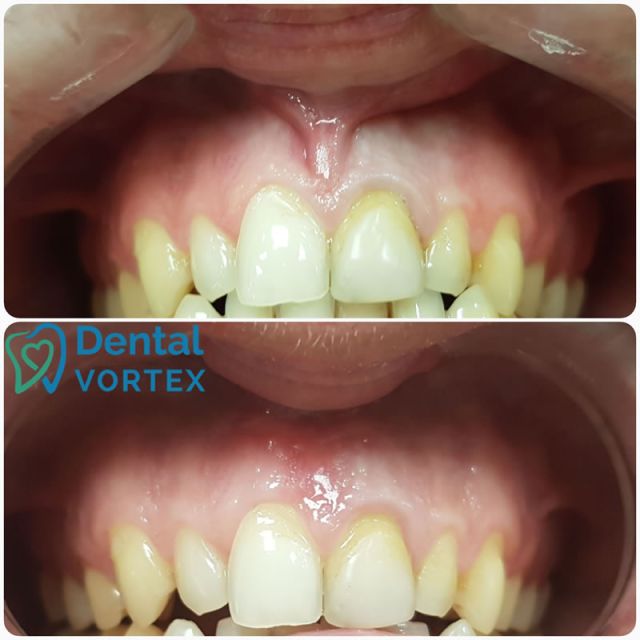
As for returning to a normal routine — most patients resume their usual activities on the same day or the following day. Discomfort in the area of the wound is mild and most often does not require more than a standard analgesic. Many patients are pleasantly surprised by how quickly the discomfort passes.
In children, parents most often notice an improvement in speech and tongue mobility within the first few weeks after the procedure, especially with the recommended exercises. If you would like to read specific experiences from our patients, we invite you to check out our reviews on Google.
Frenectomy cost
The cost of the procedure at DentalVortex depends on the chosen method:
| Service | Price |
|---|---|
| Frenectomy | 8000 RSD |
| Laser frenectomy | 12000 RSD |
Frequently asked questions about frenectomy
Schedule an appointment at DentalVortex
If you have recognized any of the problems described, or are unsure whether the frenulum is the cause of the symptoms you are experiencing, the first step is simple: schedule an appointment.
DentalVortex dental clinic in Belgrade performs frenectomy using both the classic surgical method and the laser method. Do not let fear of the dentist continue to stand between you and a healthy smile. The clinic is located at Živka Davidovića 96A/14, Zvezdara, Belgrade, in the East Side complex, next to the Aviv Park shopping center.