
What are metal-free crowns
Metal-free crowns are today the most popular choice when a damaged tooth needs to be replaced or protected. These are prosthetic restorations (artificial teeth placed over a prepared natural tooth or an implant) made exclusively from ceramic materials, with no metal substructure whatsoever. This is precisely what gives them an appearance almost identical to a natural tooth.
They combine esthetics, strength, and biocompatibility (they do not cause tissue reactions) in a way that older metal-ceramic crowns could not.
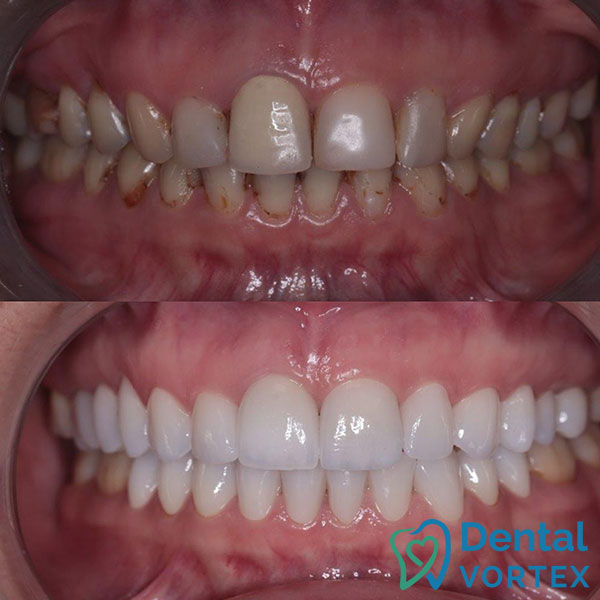
Dental Vortex clinic fabricates metal-free crowns using CAD/CAM technology and an intraoral scanner, which means the entire process — from taking the impression to the finished crown — proceeds precisely and without any uncomfortable experiences for the patient.
What metal-free crowns are made of
Metal-free crowns are made from ceramic materials that, as the name implies, have no metal substructure. In dental practice today, two materials are most commonly used:
Zirconia crowns – Zirconium dioxide
Zirconium dioxide is currently the most widely used material for fabricating metal-free crowns. It is an exceptionally high-strength ceramic that transmits light in the same way as a natural tooth, giving a completely natural appearance.
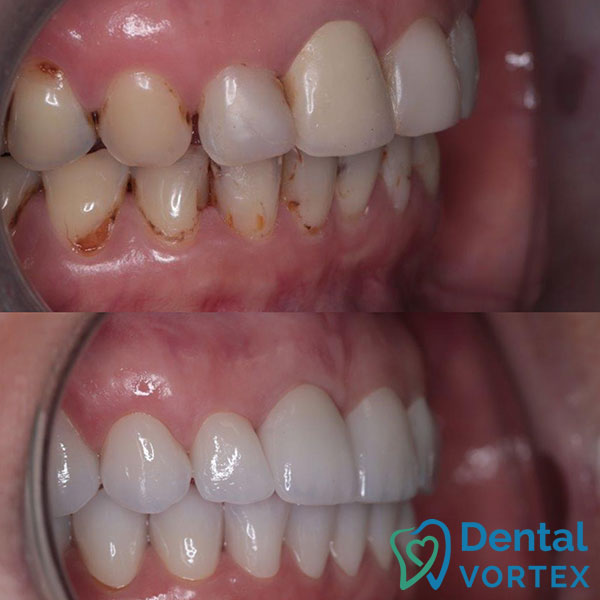
The material from which zirconia crowns are made is biocompatible, meaning it does not cause allergic reactions or gum irritation. It can be used for both front and back teeth, as well as for crowns on implants. Due to its hardness, zirconia could not be processed by standard methods for a long time. Only with the advent of CAD/CAM systems in the 1990s did it become possible to shape it precisely using computers, which is why it is so widespread in dentistry today.
Lithium disilicate (E.max)
Lithium disilicate, also known by the commercial name E.max, is slightly less hard than zirconia, but esthetically even more natural-looking. Light passes through it in a way that is the most translucent of all available materials, making it an ideal choice for front teeth where esthetics are the priority.
It is important to note that E.max crowns are not suitable for placement on implants or teeth reinforced with a cast post and core, because the darker color of the metal could show through the crown. In those situations, zirconia remains the better choice.


What the metal-free crown placement procedure looks like
Many patients postpone visiting the dentist because they do not know what to expect. The metal-free crown placement procedure is predictable, well-structured, and requires no special recovery period. At Dental Vortex clinic, the entire process looks like this:
Examination and planning
The dentist first assesses the condition of the tooth and determines whether a crown is the right solution. If the remaining teeth need whitening, this is the ideal time to do it before selecting the shade of the crown.
Tooth preparation
The tooth is prepared for the crown by grinding it down, usually to the gum line. The procedure is always performed under local anesthesia, making it completely painless.
Taking the impression
Instead of traditional impression materials and trays, an intraoral scanner is used to digitally capture the tooth. The procedure is fast, precise, and completely comfortable for the patient.
Shade selection
Together with the dentist, you choose the shade that most naturally blends in with the rest of your smile.
Temporary crown
While the final crown is being fabricated in the laboratory, you receive a temporary crown that protects the prepared tooth.
Try-ins and adjustments
During fabrication, the dentist and technician check the shape, length, and shade. Any necessary adjustments are made in consultation with you.
Cementation
The final crown is placed and secured through a process called cementation. After that, the difference between the crown and a natural tooth is virtually invisible.
The entire process requires an average of three to four visits to the clinic and takes between three and ten days, depending on the number of crowns being fabricated.
Does placing a metal-free crown hurt
The answer is clear: the procedure is not painful. Tooth preparation is always performed under local anesthesia, and taking the impression with an intraoral scanner is completely painless.
For patients who have significant dental anxiety, in addition to local anesthesia, inhalation sedation is also available as an additional option for a completely relaxed experience during the procedure.
After the procedure, mild sensitivity is possible, but it resolves on its own. There is no recovery period, so you can return to your daily activities the same day. What is important to remember: fear of pain should not be a reason to delay treatment.
Inhalation sedation
If you are anxious, at Dental Vortex we offer the option of inhalation sedation (laughing gas). You will feel a pleasant sense of relaxation during the procedure, and the effect wears off as soon as the mask is removed.
Who are metal-free crowns the right solution for
Metal-free crowns are suitable for a wide range of patients. They are most commonly recommended in the following situations:
- The tooth is broken, cracked, or so damaged that a filling cannot adequately restore it
- The tooth is devitalized (a non-vital tooth that has undergone endodontic treatment) and needs protection
- There is an esthetic issue — a change in the color or shape of a tooth that affects the appearance of the smile
- A crown is being placed on a dental implant
- The patient has periodontitis (a disease of the gums and bone that supports the tooth) and a bridge is needed to splint (stabilize) the teeth
Metal-free crowns can be used for both front and back teeth. For premolars and molars (the back teeth used most during chewing), zirconium dioxide is recommended due to its greater strength, while for front teeth, lithium disilicate is sometimes the better choice due to its superior translucency.
There are no medical contraindications for metal-free ceramic. The material is biocompatible and does not cause allergic reactions.
The difference between a metal-free crown and a metal crown
A metal crown (known in dentistry as a metal-ceramic crown) was long the standard in prosthetics. Today, metal-free crowns have largely taken the lead, for several concrete reasons.
Metal-free crown
- No metal substructure
- Transmits light (natural, three-dimensional appearance)
- Does not cause gum irritation or discoloration
- Less aggressive tooth preparation
- Surface resistant to acids, does not retain deposits
Metal-ceramic crown
- Contains a metal substructure (coping)
- Does not transmit light (gives the tooth a matte appearance)
- A dark line appears along the gumline over time
- Possible reactions in patients with metal allergies
- More aggressive removal of tooth structure
The only area where metal-ceramic crowns still have an advantage is price. Metal-free crowns are more expensive, but the price difference is offset in the long run by their durability and the absence of esthetic complications.
Caring for metal-free crowns
A properly placed zirconia crown can last 10 to 15 years, and even longer with good maintenance. The key to longevity is not the material itself, but regular and proper oral hygiene.
A few practical tips:
- Brush your teeth at least twice a day, using circular motions and gentle pressure
- Use interdental brushes to clean the spaces between the crown and adjacent teeth
- For cleaning under bridges, Superfloss is helpful (a special dental floss with a stiffened end)
- An oral irrigator promotes gum health around the crown
- Regular check-ups with your dentist and annual panoramic X-rays allow timely detection of any changes
Metal-free ceramic does not change color over time and is resistant to acids from food and beverages. The surface of the material does not retain deposits in the same way as metal, which makes maintenance easier and reduces the risk of gum inflammation around the crown. A check-up with your dentist once or twice a year is recommended so that any changes to the crown or surrounding tissue can be detected in a timely manner.
Metal-free crown prices at Dental Vortex clinic
| Service | Price |
|---|---|
| Metal-free crown (zirconia) | 25000 RSD |
| High-aesthetic metal-free restoration | 28000 RSD |
| Metal-free crown on implant | 45000 RSD |
The price includes all visits during the fabrication process, try-ins, and any adjustments to the shape, length, or shade made in consultation with the patient. The price is always communicated upfront, before any treatment begins. For an accurate assessment and an individualized treatment plan, we invite you to schedule a consultation.
Frequently asked questions about metal-free crowns
Schedule a consultation
If you recognize yourself in any of the reasons for having a metal-free crown placed, the next step is simple: schedule an appointment. During the first visit, the dentist will assess the condition of your teeth, recommend the optimal solution, and inform you of all costs in advance.
Do not let fear of the dentist continue to stand between you and a healthy smile. At Dental Vortex clinic in Zvezdara, Belgrade, a warm welcome, a patient team, and a solution that turns anxiety into relaxation await you.
The clinic is located at Živka Davidovića 96A/14, Zvezdara, Belgrade, in the East Side complex, next to TC Aviv park.