
Clear aligners for teeth straightening (also known as aligners or invisible braces) are transparent, removable trays that gradually move teeth into the correct position. Unlike fixed braces, they are not bonded to the teeth and are virtually unnoticeable during wear. At Dental Vortex, we have been using this method for over 15 years — since aligners first appeared in Serbia. Each set of trays is made from a digital impression of your teeth, which means the treatment is not generic but precisely tailored to your case.
During the examination, the dentist determines whether your case is suitable for aligner therapy. Not all irregularities can be resolved in this way, so this is the first and most important step, without any obligation.
Note: if the dentist determines that therapy is possible, the next step is a 3D analysis and treatment plan, the cost of which is 6,000 RSD.
Misaligned teeth are not just an aesthetic problem. According to available data, about 70% of adults have misaligned teeth, and nearly half of them need orthodontic correction. Crowded and overlapping teeth make it harder to maintain hygiene, which over time can lead to plaque buildup, cavities, gum disease, and accelerated development of periodontitis. Aligners allow these irregularities to be corrected in a comfortable and discreet way. If you have been thinking about straightening your teeth but were put off by the thought of metal brackets, aligners are definitely what you are looking for.
What are clear aligners and how do they work?
Aligners work on a simple principle: each tray is made to be slightly different in shape from the current position of your teeth. When you put it in, the aligner applies gentle, constant pressure that slowly moves the teeth toward the desired position. Once that aligner has done its part, you move on to the next one in the series. The material they are made from is a medical-grade thermoplastic (most commonly polyurethane-based) — a thin, transparent plastic so lightweight that most patients barely feel it on their teeth.

What the process looks like, step by step
Examination and assessment
First, we determine whether aligners are the right solution for your case. Not all irregularities are suitable for this type of treatment.
Digital scanning
Instead of traditional impression materials and trays, we scan your teeth with a digital scanner. We obtain a precise 3D model of your jaw. The entire process is based on CAD-CAM technology, which enables computer-aided design and fabrication of aligners with high precision.
3D analysis and treatment animation
Software simulates the movement of the teeth based on the scan and divides it into steps. You receive this 3D analysis and animation of the entire process by email. This means that before you even begin wearing your aligners, you can see exactly what your teeth will look like at the end of treatment. Each aligner moves the teeth approximately 0.2 to 0.3 mm, which is considered a physiological rate of movement.
Aligner fabrication
A set of aligners is produced based on the treatment plan.
Wearing and check-ups
You wear each aligner for two to three weeks (usually two), then move on to the next one. The exact interval is determined by the dentist based on your treatment plan.
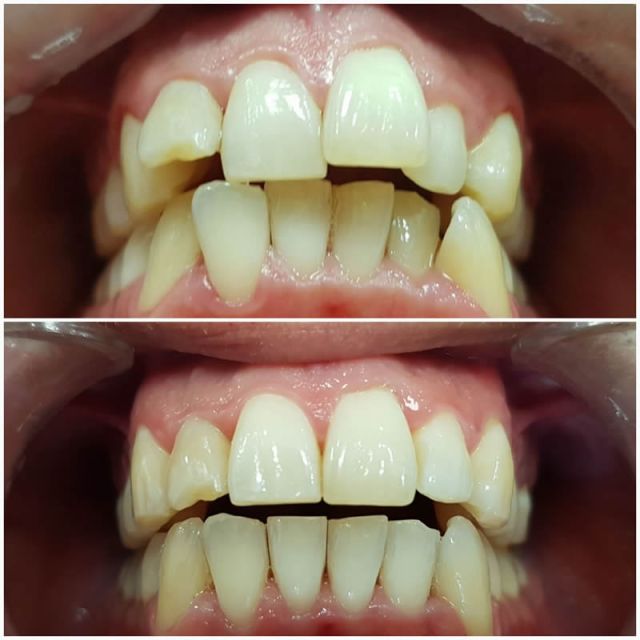
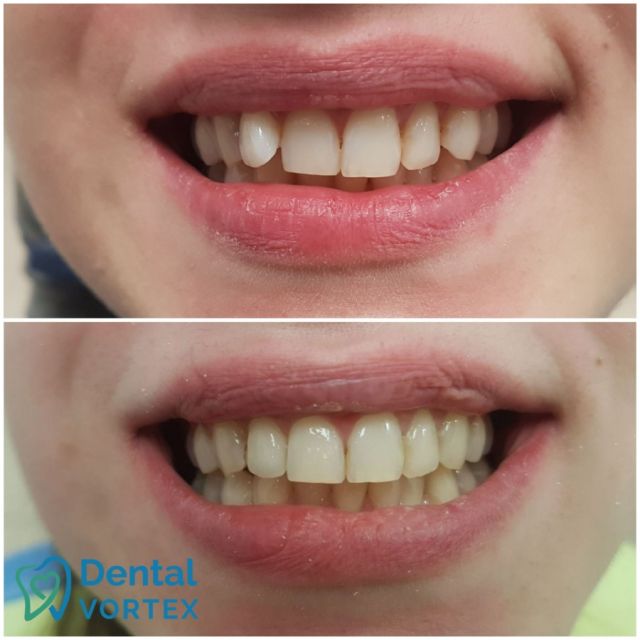
One important note: sometimes, before starting treatment, interproximal reduction (IPR) is required. This is a procedure in which the side surfaces of certain teeth are minimally narrowed — usually by 0.2 to 0.5 mm — to create space for movement without tooth extraction. The procedure is painless and takes only a few minutes.
Do aligners hurt and what should you expect during treatment?
Most patients do not report pain during aligner treatment, but some degree of pressure does exist. When you put in a new aligner in the series, it is normal to feel mild pressure or tension in your teeth for the first day or two. This is a sign that the aligner is doing its job. That feeling passes quickly, and most patients get used to it after the first or second aligner.
Unlike fixed braces, there are no wires or brackets that can irritate the inside of the cheeks or gums. Aligners are smooth and shaped to fit your teeth, making everyday wear considerably more comfortable.
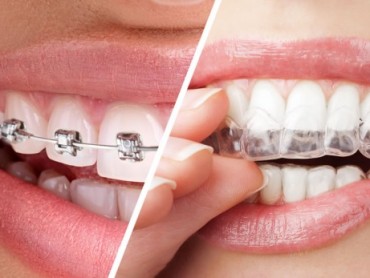
A few things you should know in advance:
- Aligners must be worn a minimum of 20 to 22 hours per day. They are removed only during meals, drinking hot beverages, and brushing your teeth.
- Hot beverages such as coffee and tea must be consumed without the aligner in place, as high temperatures can deform the material.
- When the aligner is not in your mouth, store it in the provided case to prevent damage or loss.
- The aligner only needs to be cleaned once a day with a toothbrush and lukewarm water until it becomes fully transparent again.
The key thing to remember: consistency in wearing your aligners is the only condition for good results. An aligner sitting in its case does not move teeth.
Advantages of aligners over fixed braces
Aligners or fixed braces: which is better for you? Fixed braces remain the gold standard for complex orthodontic corrections. But for minor and moderate irregularities, aligners offer several practical advantages that many patients value more in everyday life. Not sure whether you need braces or whether you can solve the problem with an aligner? Contact us.
Aesthetics
Aligners are transparent and nearly unnoticeable. At a normal conversational distance, no one will notice you are wearing them.
Hygiene
Because they are removable, you use your toothbrush and floss completely normally. There are no hard-to-reach areas around brackets where plaque builds up.
Comfort
There are no metal wires or brackets that can irritate the inside of the mouth. Aligners are smooth and shaped to fit your teeth.
Flexibility
You can remove them during an important meeting, a special occasion, or a meal. Fixed braces do not offer that option.
Treatment predictability
Thanks to the 3D analysis, before you even begin treatment you can view a simulation of what your teeth will look like at the end. This is something traditional braces cannot offer in advance.
It is important to be honest: aligners are not the solution for every case. For complex bite irregularities, severely rotated teeth, or the need for vertical tooth movement, fixed braces deliver better results. At your consultation, we will tell you whether you are a candidate for aligners or whether a different approach would be more effective.
Who are clear aligners intended for?
Aligners produce good results for minor and moderately pronounced irregularities in the position of the front teeth. In practice, this covers the majority of cases that patients present with.
Aligners are suitable for:
- Crowded or overlapping teeth in the frontal region (front part of the jaw)
- Gaps between teeth that you want to close
- Improper tooth angulation, especially of the front teeth
- Mild tooth rotations
- Correction after wearing fixed braces, when the teeth have shifted slightly due to insufficient retention wear
Aligners are not suitable when there are:
- Complex bite irregularities requiring precise force control
- Severely rotated canines or premolars
- A need for vertical tooth movement
- Dental bridges in the dental arch
There is no strict age limit. Adult patients and older teenagers whose jaw development is complete can use aligners without restriction. Assessment is done individually, based on the condition of your teeth and jaw.
Our experience tells us that about half of all cases of misaligned teeth can be successfully treated with aligners. For the other half, other methods exist, and we will always be straightforward with you about which group you fall into.
Cost of aligner treatment at Dental Vortex
The cost of aligner treatment is not fixed and cannot be determined without an examination. It depends on the number of aligners that need to be worn, which is only established after digital scanning and 3D analysis of your jaw. What we can share in advance are the prices of individual treatment elements:
| Service | Price |
|---|---|
| Clear aligner for teeth straightening | |
| Correction aligner | 6000 RSD |
| Retainer tray / retainer | 10000 RSD |
| Fixed retainer and retainer tray | 16000 RSD |
After treatment is complete, two forms of retention are used to prevent the teeth from returning to their original position. A fixed retainer is a thin wire bonded to the inside surface of the teeth and worn permanently — you cannot feel it and it is not visible. A retainer tray is a transparent tray worn for longer periods during the day in the first month after treatment, after which you gradually transition to wearing it only at night.
The total number of aligners, and therefore the final cost of treatment, is determined after the first examination. At that point, you receive a complete plan by email with all the steps and the estimated duration of treatment.
What most commonly holds patients back from starting treatment?
The two most common reasons are cost and time. However, when compared with the long-term consequences of crooked teeth — from tartar buildup and cavities to gum disease — teeth straightening becomes an investment in health, not an expense. Aligner treatment takes only a few months, and the results are permanent with proper retention.
Frequently asked questions
Schedule an appointment in Belgrade without anxiety
If you have not been to the dentist in years and feel embarrassed about it, there is no reason for guilt. In over 15 years of experience, we have seen patients who have waited even longer. What matters is that you are ready to take the first step.
Do not let fear of the dentist continue to stand between you and a healthy smile. At Dental Vortex in Belgrade’s Zvezdara neighborhood, a warm welcome, a patient team, and a solution that turns fear into calm all await you.
The clinic is located at Živka Davidovića 96A/14, Zvezdara, Belgrade, in the East Side complex, next to Aviv Park shopping center.